Retail shelf planning · Blender
A planning export in. A dressed bay out.
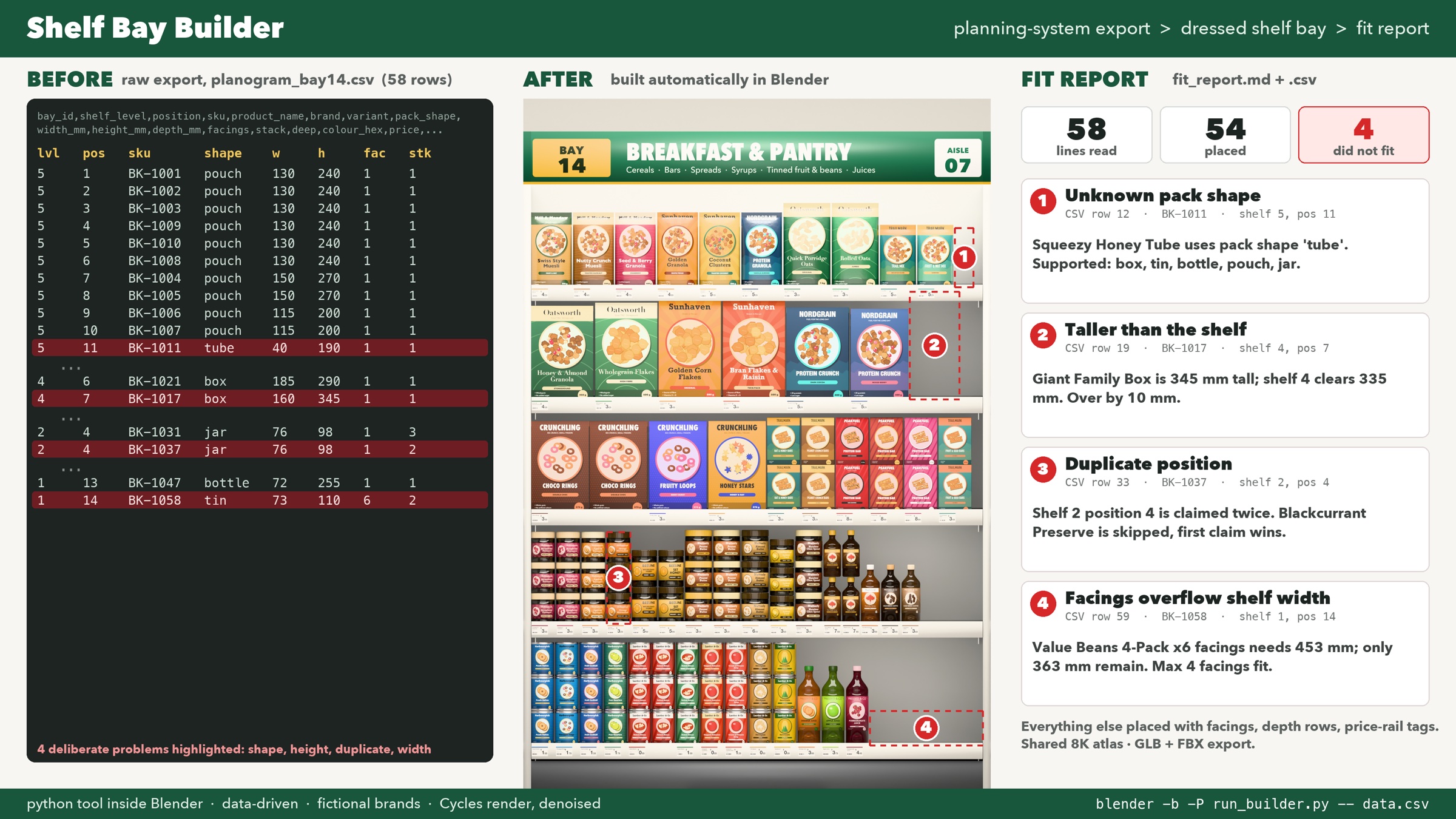
A Python tool inside Blender that reads a shelf-planning export, builds the bay with real-scale packs, tells you exactly which lines could not be placed and why, and renders the review images, so nobody dresses a bay by hand.
Walkthrough · 20 s · rendered in Blender, fictional brands
Export to bay to report
One run, three outputs.
- 1
Read the export
CSV or JSON from the planning system: bay, shelf level, position, SKU, pack shape, dimensions, facings, stack, depth.
- 2
Check every line
A fit check places or rejects each line with a reason and a suggested fix, so the bay never contains a pack that could not exist.
- 3
Build and render
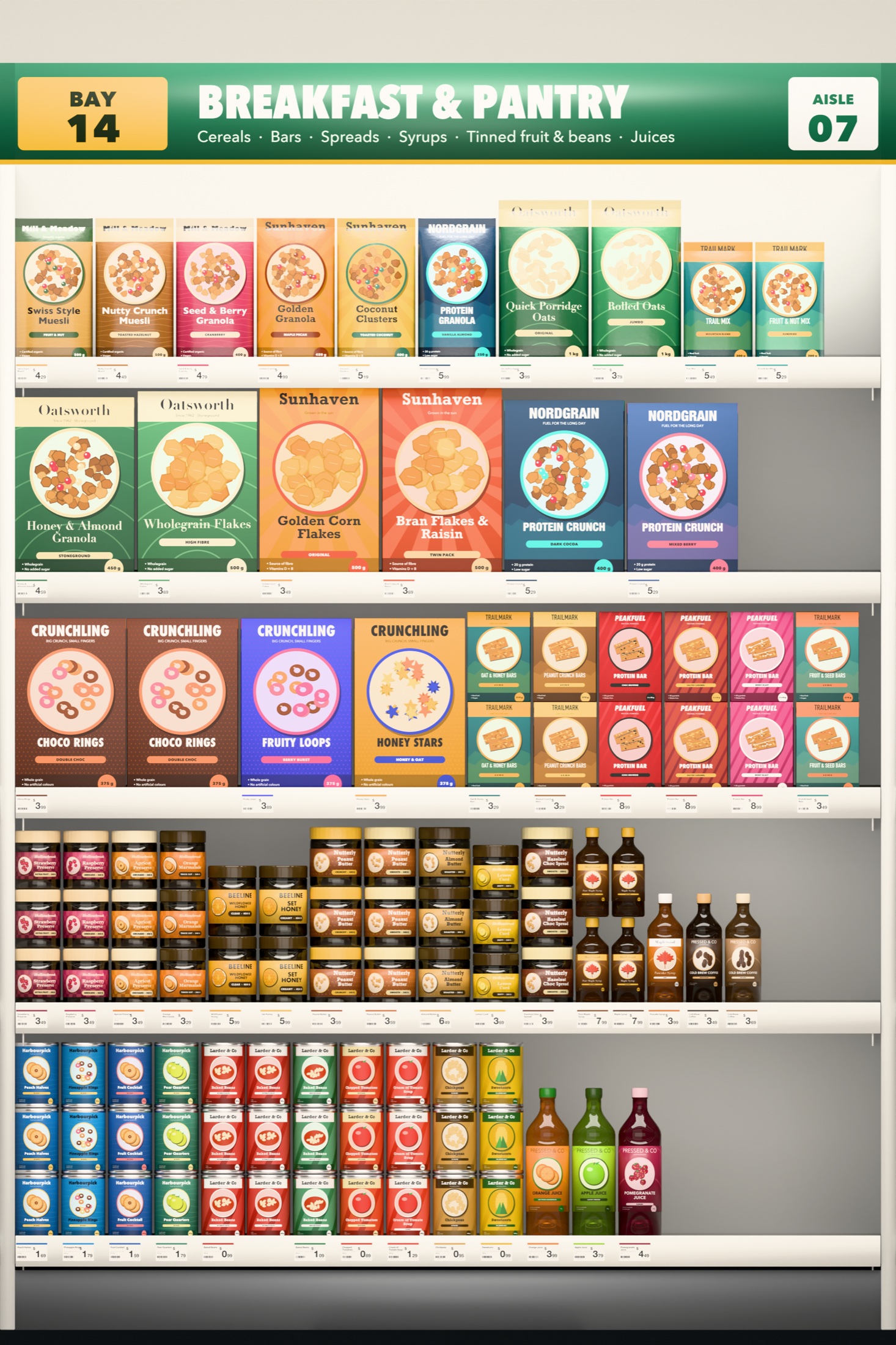
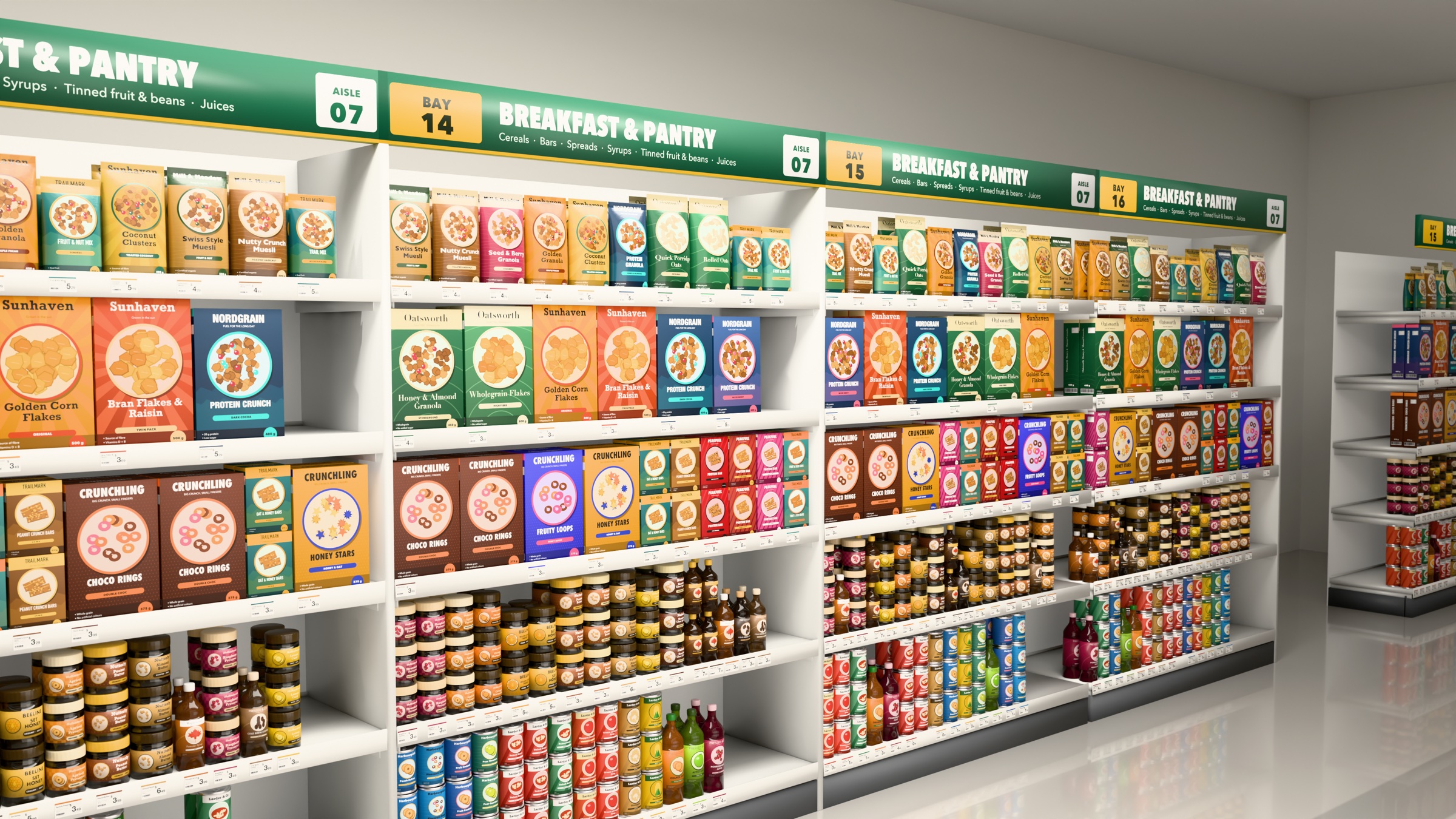
Real-scale packs with one shared label atlas, price-rail tags, a planogram view and an aisle view, plus GLB and FBX exports.
The two review images
Straight on, and down the aisle.
The fit report
58 lines read. 54 placed. 4 caught.
The demo export carries four deliberate problems. Every one is reported with its CSV row, the reason and a suggested fix. Rejected lines are never modelled.
CSV row 12 · BK-1011
Unknown pack shape
Squeezy Honey Tube uses the shape 'tube'. Supported shapes: box, tin, bottle, pouch, jar.
CSV row 19 · BK-1017
Taller than the shelf
Giant Family Box is 345 mm tall and the shelf clears 335 mm. Over by 10 mm.
CSV row 33 · BK-1037
Duplicate position
Shelf 2 position 4 is claimed twice. The first claim wins and the second is reported.
CSV row 59 · BK-1058
Facings overflow
Six facings need 453 mm and only 363 mm remain. The report suggests a maximum of 4.
What you receive
The tool, and its proof.
- The scene with the builder and the built bay (.blend)
- The exported model (GLB and FBX) and the shared 8K label atlas
- Two review images: a straight-on planogram view and an aisle view
- The fit report (CSV and readable), listing every line that did not fit
- A one-page handoff note: how to run it, the data format, how the checks work
Honest limits
What it does not do yet.
- Shelf-level planning only: no peg hooks, vertical dividers or multi-bay runs in one CSV.
- The demo uses fictional brands and a procedural label atlas. With real artwork, the atlas cells are swapped and the rest stays.
- Pouch shading is subtle, and the art is clean and illustrative, not photographic.
- Review renders are fast on a GPU. A CPU-only machine works but is about ten times slower.
Send one real export. See your own bay.
Your export, your shelf specs, your artwork. The first built bay comes back inside three days.